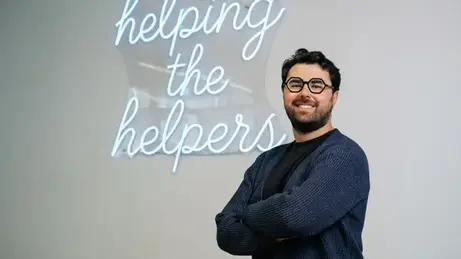
In this episode of Coffee Chats, Yoko Ozaki, CPA, reflects on her journey from serving in the Japanese military to building a new career in Canada, and the skills that helped her succeed along the way.
A career change doesn’t get much bigger than this. Before moving to Canada, chartered professional accountant (CPA) Yoko Ozaki spent more than a decade serving as an officer in the Japanese military. Today, she works as a senior assurance associate at PwC in Vancouver.
While the transition may seem unlikely, her journey highlights how internationally trained professionals can find successful careers through the CPA profession, turning transferable skills and determination into new opportunities in Canada.
How curiosity set her first career in motion
Ozaki grew up in the Japanese countryside surrounded by mountains and the ocean. “Life was peaceful and slow-paced – very different from the life I have today,” she recalls. As a child, her interest in the wider world was inspired by a love of reading and the nearby military air base. “I would see fighter jets flying overhead and I remember thinking, ’I want to be part of that world someday,’” she says.
This aspiration led her to attend Japan’s National Defense Academy, which educates students who will serve in the Japanese military. While earning a university degree, she studied engineering, technology, leadership, and military strategy, while also completing field exercises, long-distance swimming, and other intensive physical training. The experience would stay with her throughout her career.
“There were many rules,” she says. “Even if you followed them, you could still be held responsible if someone on your team made a mistake. At the time it felt tough, but it taught me valuable skills – teamwork, accountability, resilience, and leadership.”

Building transferable skills while traveling the world
After graduating, Ozaki served for more than a decade in the Japan Air Self-Defense Force, progressing from cadet to captain. One highlight of her military career was joining the crew of the Japanese Government Aircraft, where she served as a cabin chief on flights that transported Japan’s Prime Minister and Royal Family. She travelled to more than 40 countries while meeting individuals from diverse backgrounds.
“What I remember most is not the destinations, but the people,” she says. “I met leaders, diplomats, and professionals from all over the world. Those experiences taught me the importance of professionalism, adaptability, and understanding different perspectives.” This position also helped her develop communication and leadership skills that would eventually prove valuable in a completely different profession.
Starting over in a new country
In 2017, Ozaki moved to Vancouver, where she experienced the ups and downs that come with starting life in a new country. “The biggest challenge was definitely the language,” she says. “Suddenly, I was trying to open a bank account, build a new career, and make friends – all in English!”
Like many newcomers, Ozaki found herself rebuilding multiple parts of her life at once. Beyond adjusting to a new culture and language, she also had to determine how her skills and experience could translate into a Canadian career.
At the same time, she discovered new opportunities. “In Canada, I discovered the freedom to be myself,” she recalls. “There is more room to be different, to change careers, and to follow a path that makes sense for you.” That sense of openness would lead her to a new career.
Changing careers and choosing CPA
Ozaki had never contemplated becoming an accountant, but after chatting with someone who had worked at PwC, she started to consider it. “I originally thought, ‘Accounting? Me?’ But I was willing to explore new possibilities,” she recalls.
After carefully thinking things through, she enrolled in the CPA program. As her studies progressed, she found that her curiosity slowly turned into passion. “I realized accounting was much more than numbers,” she says. “It helped me understand how organizations work, how decisions are made, and what drives businesses to succeed.”
What began as curiosity gradually evolved into a new professional direction. As she progressed through the CPA program, Ozaki began to recognize that many of the skills she had developed in the military such as discipline, teamwork, leadership, and problem-solving remained highly relevant in her new career.
Read more
- Becoming a CPA in BC as an internationally trained accountant
- A CPA designation makes any career change plausible
- Rooted in integrity: Pedro Villa’s path to leading with purpose
Moving forward with persistence and support
In her current role as a senior assurance associate, Ozaki helps ensure that organizations’ financial statements are accurate and reliable, so that investors, lenders, and other stakeholders can make informed decisions. “I perform detailed audit testing, and I also help plan audits, coordinate projects, and keep our teams moving toward deadlines,” she says.
While earning the CPA designation was rewarding, the journey wasn’t always smooth. “I failed some CPA exams along the way, and there were times when I felt discouraged and questioned whether I was good enough,” she says. On top of this, Ozaki was learning accounting in a second language while trying to build a new life and career. She remembers, “There were moments when I felt overwhelmed, but looking back, I’m very glad I didn’t give up.”
These experiences are one reason she is passionate about mentoring CPA students, including newcomers and career changers. “People often underestimate the need for emotional support and encouragement during their education,” she says. “Career changes often focus on learning new technical skills. However, learning something new involves asking basic questions and making mistakes, so you’re also rebuilding your confidence.”
Why becoming a CPA is a powerful second career
Looking back, Ozaki believes one of the biggest misconceptions about career change is that people need to start from scratch.
“My biggest piece of advice is that no experience is ever wasted. The skills I developed in the military, including discipline, teamwork, leadership, communication, and problem-solving are still useful every single day. So instead of focusing on what you’re leaving behind, focus on what you’re bringing with you,” she shares.
Ozaki’s journey demonstrates that building a new life and career in Canada doesn’t mean leaving previous experiences behind. Instead, it often means finding new ways to apply them.
“A career change can feel scary,” she says. “But if you’re curious, willing to learn, and open to new opportunities, the CPA path can take you further than you expect.”
Photo courtesy of BBZ Productions.
Leah Giesbrecht is a communications specialist at CPABC.