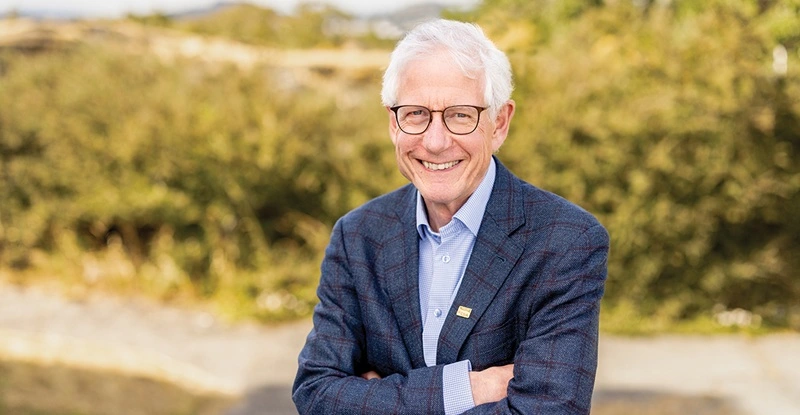
CPABC Board Chair Sandy Stedman, FCPA, is focused on the road ahead
As a teenager, Alexander (Sandy) Stedman would never have imagined that he’d go on to build a career in professional accounting with more than 30 years in public practice, over 20 years as a writer and teacher of tax courses, and more than 20 years as a volunteer in governance.
“I wanted to be a truck driver,” he says. “I definitely did not want to be an accountant. My father was a CA, but I really had no idea what he did at work. And I was always interested in transportation. I liked the idea of a job that was out and about, of travel. On top of that, trucking was actually trendy at that time—in movies, songs, and TV shows. I expect I saw it as more of a romantic ‘open road’ lifestyle than it actually was.”
While still in high school, Sandy saved up his money and got a Class 3 licence to drive non-passenger trucks. He began driving on weekends for a predecessor of Loomis Couriers. After graduating from high school in 1976 and spending the next year working odd jobs, he saved up for his Class 1 licence and then decided to enrol in university rather than hit the open road.
It wasn’t a perfect fit.
“I didn’t work too hard, and I got the marks you would expect,” Sandy says of his first year at UBC. “After that, I started driving for a company called CP Transport.”
And in his time off, riding motorcycles.
“I had a Suzuki GS1000, which was blindingly fast,” he says, adding: “I did a lot of things on wheels in my 20s.”
Even so, Sandy was already thinking about returning to university when he met his future wife Roxanne in 1979. Her encouragement tipped the scales.
“She thought I could do it, and so I went back,” he says. “I went into commerce thinking I was going to try to get into management in the trucking industry. But at the end of my first year of commerce, I had to pick an area of specialization, and I had only two subjects with really good marks: accounting and computer science. My identical twin brother was already in computer science, and I didn’t want anyone thinking ‘Isn’t it cute that the twins are both in computer science?’ So I chose accounting.”
While working toward his degree, Sandy started driving with Loomis again.
“I enjoyed doing the line haul trips when I was in school,” he says. “I mainly drove at night, and it was pretty peaceful. And by then, I knew it wasn’t going to be for the rest of my life. It was a pretty good deal—I was making good money for what was often a night’s work—but I couldn’t carry a full course load while driving on a regular basis, even if it was just once a week.”
So university took a bit longer, but Sandy made it work, graduating from UBC with a bachelor of commerce degree in accounting in 1984. That same year, Roxanne completed an internship as a dietitian, and the pair married and moved to Abbotsford, where Sandy began articling with Thorne Ernst & Whinney.
“We were trying to hit all of the stressors we could in one year,” he says with a laugh.
Sandy earned his designation in BC in 1987 and worked as a manager with Thorne Ernst & Whinney for two more years before leaving public practice to join Fletcher Challenge Canada, an international forest products company based in Vancouver, as an internal auditor. Then, in 1991, he made the move to DCD Management, a group of privately held companies in Vancouver, serving as controller.
“When I started with DCD, there were a lot of problems to fix,” he says. “So I fixed them. And the first year after I got everything working really well, it was kind of nice to be able to relax. But then it got boring. I thought, ‘What do I want to be doing?’ And when I looked at what I enjoyed and found rewarding, it was talking to people, getting to understand their businesses, and working on projects.”
Sandy decided it was time to return to public practice. He joined Robson Dale Carr-Hilton in Vancouver in 1995 and stayed with the firm for a year before an opportunity on Vancouver Island sparked the idea of moving out of the city. In 1996, Sandy joined Schibli & Chenard in Victoria as a partner, forming Schibli Stedman Chenard. Within two years, the firm became Schibli Stedman King, and it was here that Sandy would spend the remainder of his career, retiring on January 1, 2026. Over that 30-year period, he helped the firm grow to more than 50 employees and partners.
“When I started, we had essentially two partners, one manager, and three technicians doing the file work,” he says. “I suggested that we hire articling students, and once we started doing that, the firm culture changed a lot. Students made the firm a great place to be, because they were really enthusiastic and keen to learn.”
Sandy also enjoyed helping long-standing clients, mostly owner-managed businesses and high-net-worth individuals, achieve their goals.
“You know, it’s a great job,” he says. “You do good things for people. We were dealing with the owners, so we were really involved, and we had very low client turnover. Some of the clients I had when I retired had been with me for 30 years. It’s really rewarding when you get to know your clients and watch them succeed.”
It was also rewarding to help his team succeed, though Sandy is quick to downplay his impact as a mentor.
“I think a lot of what I did early on to support employee development was actually mentoring, but I didn’t specifically focus on ‘mentoring’ until near the end of my time in public practice, when I wanted to make sure I was leaving the firm in a good place,” he says. “If I was doing it over again, I would mentor more deliberately and earlier in my career. I think it takes a while to realize that maybe you have something to offer to people who are all really smart.”
Humble words from someone who has contributed a great deal to the accounting profession since he first became involved in 1989.
“I started volunteering in the profession because I wanted more contact with my peers,” he says. “I was at Fletcher Canada then, and most of the staff outside of internal audit weren’t accountants.”
After signing up to volunteer (a general call to action in those days), Sandy was chosen for the ICABC Communications Committee. He served for a full five-year term, and after returning to public practice in 1995, he began a five-year term with the Practice Review and Licensing Committee.
“With anything I’ve ever volunteered for, I’ve ended up getting back more than I put in,” he says. “And one of the great things about volunteering in the profession is that you’re meeting and working with some really, really bright people.”
Sandy’s early committee work was just the beginning, as he went on to volunteer for more than 25 years as a member of the CPABC Tax PD Subcommittee and for more than 23 years as an author and instructor of tax courses. Somewhere along the way, the teenager who’d never envisioned a career in accounting became an expert known for making tax fun.
“You know, it was never the plan,” says Sandy. “It’s like so much in life—just a series of random events that happen to work out fairly well. For the type of client base we had at the firm, tax was the driving issue, so that’s what I worked at. Plus, it’s really hard to teach a course—let alone write a course—without learning the stuff, so that helps you get even better at it. And I really enjoyed both.”
Still, teaching had a learning curve.
“The first few years were… difficult,” he says. “But when I got the evaluations, I would look really carefully at the criticisms and ask myself what I needed to change and how I could make things better. It’s like everything else: Success is a poor teacher; failure is a much better one. And I’ve been lucky to have a lot of good teachers.”
Case in point: Sandy failed the legacy qualifying exam the first time he wrote it.
“In high school and university, I tended to coast,” he says. “So when it came to writing the UFE the first time, I didn’t really know how to study or write an exam. Up until that point, I’d just sort of shown up and hoped for the best. I needed the failure so I could learn something.”
Learning has been a priority ever since, and it remains top of mind for Sandy in his current role.
“There are a lot of big things happening this year, but the new education program is particularly important to me,” he says. “I think having a seamless transition to the new program, creating one that works for all students, and developing really good CPAs are the most important jobs we’ve got to get done in the next year or so.”
Sandy has already helped support students through three years of service as a governor of the CPA Education Foundation, which he describes as “a great organization”—one he was sorry to step down from when he started on the ladder to chair in 2024.
In tandem with his long-standing activities in the profession, Sandy has a lengthy history of community service with organizations such as Scouts Canada, St. Michael’s University School, and the Victoria Conservatory of Music. These volunteer contributions in and outside of the profession, combined with his professional achievements, garnered him an election to CPABC Fellowship in 2018.
Looking ahead to what retirement has in store beyond his current role at CPABC, Sandy says he’ll be spending more time with family. He and Roxanne have three children—two sons living in Silicon Valley and a daughter living in Phoenix—and the couple’s first grandchild will be turning one in August. The pair also plan to travel more of the world and stay active.
“My wife accurately describes me as a workaholic,” says Sandy. “I got a lot of pleasure out of my work, so I’d like to stay involved with something that keeps my brain engaged. And given that my wife is very much into hiking and cycling, I have an opportunity to stay fit by trying to keep up with her. Beyond that, there are no concrete plans.”
If the past is any indication, Sandy will find a way to keep moving forward.
Michelle McRae is the managing editor of CPABC in Focus magazine.
This article was originally published in the September/October 2026 issue of CPABC in Focus.