On January 15, 2026, CPA Canada issued information respecting its new membership model. This was expected given the previously announced administrative and governance changes involving CPA Canada and the provincial and territorial CPA bodies (PTBs), which will take effect on April 1, 2026.
As a reminder, your current CPA Canada membership will continue until March 31, 2026. If you wish to continue as a CPA Canada member, you will need to register directly with CPA Canada, as outlined in their email communication. It is important to note that CPA Canada is not a regulatory body and does not regulate CPAs.
Note: The following information is also pertinent to both members of CPABC and CPA Yukon.
CPABC Annual Member Dues
CPABC’s mandatory fees are set to cover the core operational costs required for us to fulfill our regulatory mandate and provide essential services to members, such as access to the handbook and guidance. It also includes funding key activities that ensure the profession is well‑supported and the public interest is protected.
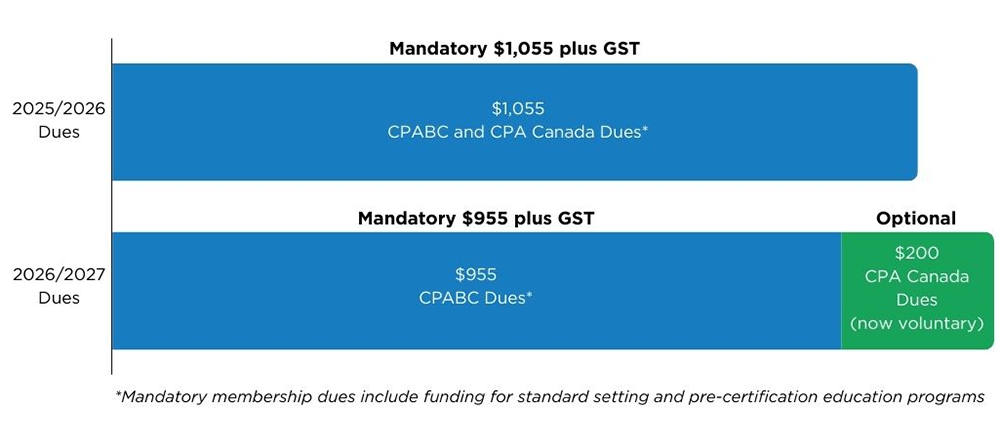
For 2025/26, the mandatory fee was $1,055 plus tax and included funding for standards, guidance, and pre‑certification. For 2026/27, the mandatory fee has been reduced to $955 plus tax, while continuing to provide funding for these same core elements.
This new funding model is reflected in the 2026/2027 membership dues schedule that will be sent at the end of February. Membership with CPA Canada is now optional, so any related fees are voluntary.
CPABC’s Regulatory Role
CPABC will continue to fulfill its primary mandate of protecting the public interest by upholding high professional and ethical standards, while supporting members with services that enable them to carry out this responsibility effectively.
To continue using the CPA designation, you must maintain your provincial membership with CPABC. Membership in CPA Canada does not permit use of the CPA designation. Going forward, individuals must maintain active CPA membership with their provincial body as a requirement of becoming a CPA Canada member under the new governance framework.
The governance and funding changes will not affect the regulation of the profession or your provincial obligations as a CPA. As noted above, members will continue to have access to the CPA Canada Handbook and applicable standards, as outlined in the FAQs.
Benefits of your CPA Designation
CPAs must continue to maintain their CPABC membership in order to use the CPA designation in BC. Your CPA designation, rights, member services, benefits, and privileges are derived from your continued membership with CPABC. This includes eligibility to seek registration in other provincial and territorial CPA bodies for inter‑provincial mobility.
All of the PTBs, including CPA Ontario and CPA Québec, will continue to collaborate and remain aligned on education and standards setting – responsibilities that have always been part of their regulatory mandate. Protecting the public interest remains central to these efforts.
CPA Canada and the provincial and territorial CPA bodies are making administrative, governance, and funding changes effective April 1, 2026.
Yes. Your current CPA Canada membership continues until April 1, 2026.
No. CPA Canada does not regulate CPAs. Regulation of the profession remains the responsibility of CPABC and other provincial and territorial CPA bodies.
CPA Canada membership becomes voluntary. Members who wish to continue must register and pay dues directly to CPA Canada and provincial bodies will no longer collect CPA Canada membership dues. CPABC will continue to collect provincial annual dues directly from members, with the next cycle beginning April 1, 2026.
Yes. Provincial dues will include a fee portion that provides funding directly from CPABC to CPA Canada to ensure continued access to CPA Canada standards and guidance materials for members, and the existing precertification program during the transition. A revised fee schedule will be shared as part of the 2026/27 dues cycle.
No. CPABC will continue to regulate the profession in BC, enforce professional and ethical standards, and protect the public interest.
Yes. To use the CPA designation, you must maintain active membership with CPABC. You do not need to be a member of CPA Canada to use the CPA designation.
CPA Canada membership alone does not permit use of the designation.
No. Your CPA designation, rights, and interprovincial mobility are based on your CPABC membership, regardless of whether you hold CPA Canada membership.
Yes. Provincial and territorial CPA bodies will continue to collaborate on education and standards, with public interest protection at the core of this work. For example, the Provincial and territorial CPA bodies will ensure common standards for admission into the profession across Canada.
Yes. Members will continue to have access to the CPA Canada Handbook and applicable standards for personal education use and personal professional use, including:
Core standards and guidance
- CPA Canada Handbook – Accounting
- CPA Canada Handbook – Assurance
- CPA Canada Public Sector Accounting Handbook
- CPA Canada Handbook – Sustainability
- Related interpretations, illustrative examples, and bases for conclusions
Education and certification materials
- CPA Competency Map
- CPA Professional Education Program (CPA PEP) materials
- Examination frameworks, sample cases, and evaluation guides
- Certification and practical experience guidance
Standards ‑related support materials
- Non‑authoritative guidance that supports the application of CPA standards
- Educational and explanatory materials tied to the standards
Personal education use means using CPA Canada content to: study or prepare for CPA certification; complete continuing professional development (CPD); support learning, instruction, or internal training programs; and understand changes to standards or professional requirements. This includes use within CPA-run education programs and internal learning activities.
Personal professional use means using CPA Canada content to: apply standards in professional practice; make professional judgments; meet regulatory or compliance requirements; support audit, accounting, advisory, or public sector work; and carry out CPA body regulatory, disciplinary, or standard setting functions. The content supports the work — it is not the product being sold.
Yes. In alignment with CPABC’s primary mandate of protecting the public interest, CPABC will continue to deliver the full range of services and supports that members have come to expect. These offerings play an essential role in enabling members to uphold the highest professional and ethical standards.