A look at the major developments shaping BC’s economy in 2026
Note to readers: As mentioned in CPABC in Focus, CPABC will now be releasing the BC Check-Up four times each year to respond to a growing need for timely and informative economic analysis.
At the start of 2025, British Columbia’s economy was poised for a rebound. This was a welcome change after the downturn experienced in 2024, when growth in real GDP was the slowest among Canadian provinces at just 1.1%. The downturn in 2024 marked a notable shift from BC’s consistent outperformance in recent years and was driven primarily by weakness in the construction and manufacturing industries. The slowing or completion of several large capital projects led to a 16.3% decline in engineering output, and residential construction activity also took a hit, dropping by 9.2% in real terms.
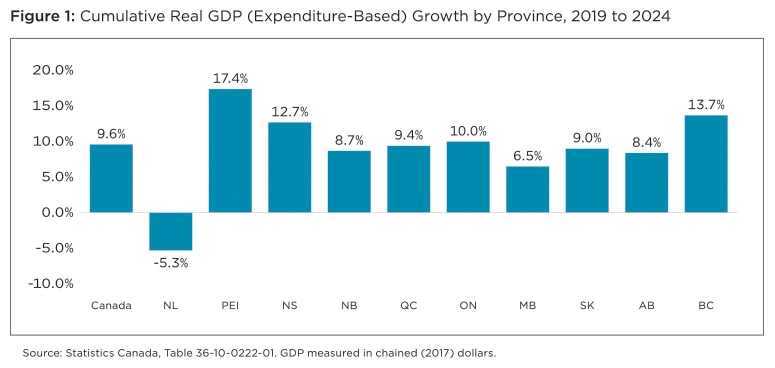
Still, BC outperformed most provinces between 2019 and 2024, growing by 13.7%—second only to Prince Edward Island (see Figure 1).
Based on recent forecasts,1 real GDP is expected to have increased by 1.7% in 2025, placing BC closer to the Canadian average. Growth is projected to remain stable in 2026 at 1.5%, and then accelerate to 1.9% in 2027 (see Figure 2).
Developments in BC’s trading relationships and slowing population growth are both expected to impact growth in the near term, while the province’s ability to attract new capital investment presents both opportunities and risks in the years ahead.

Trading relationships remain a priority ahead of CUSMA review
As was the case in 2025, international trade presents the greatest source of volatility and uncertainty when it comes to our national and provincial economies in 2026. Canada entered the new year without a resolution to the ongoing trade dispute with the United States, following a breakdown in bilateral negotiations in October 2025.2 While the Canada-United States-Mexico Agreement (CUSMA) review scheduled for July 2026 provides an opportunity to advance discussions, the policy environment remains fluid.
At the time of this writing in late January, US tariffs applied to a long list of Canadian products, including industrial metals, passenger vehicles and parts, energy products, and some wood products, with some exemptions for CUSMA-compliant goods.3 The US also increased duties on softwood lumber in 2025 (more on this below).
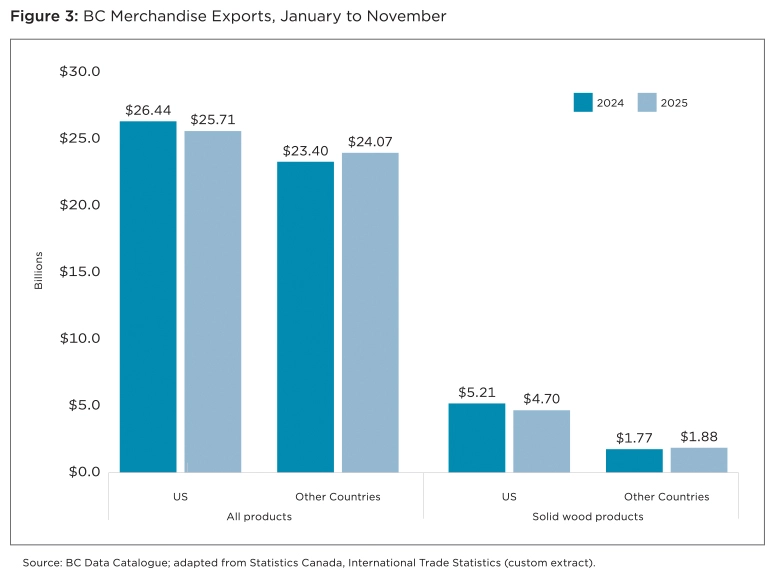
For British Columbia, which is less dependent on the US as a trading partner than most other provinces, these tariffs have still had a meaningful impact. As of November 2025, for example, BC’s year-to-date exports to the US were down 2.7%, compared to a 2.8% increase for the rest of the world (see Figure 3). And it’s worth noting that data from recent months has shown greater volatility, as the list of targeted products has expanded.
Imports from the US dropped by 8.6% year-over-year in 2025, while imports from other countries increased by 7.4%.
One area of particular vulnerability is BC’s forestry sector. During the summer of 2025, the US increased countervailing and anti-dumping duties on Canadian softwood lumber, adjusting the combined rate to roughly 35% for most producers. It then followed this move by applying an additional tariff of 10% in October 2025.4 The industry structure in Canada has long been a trade irritant for our southern neighbour, which has argued that provincially set stumpage fees constitute an unfair subsidy, which Canada disputes.
The impact on BC’s forestry exports has been significant and swift—in November 2025 alone, BC’s exports of solid wood products to the US fell 35.7% year-over-year to $293.0 million. This paints an even bleaker picture for the industry than the year-over-year drop of 9.8% between January and November 2025. And although BC increased its exports of solid wood products to other countries in 2025, it was only by 6.4%—not enough to close the gap.
The increased levies have exacerbated the challenges faced by producers, contributing to a number of mill closures, curtailments, and production pauses. Producers have often cited a lack of economically viable timber.
Canadian politicians seek to boost ties with non-US countries
In lieu of a mutually beneficial resolution to the Canada-US trade dispute, which for now remains elusive, both the federal and provincial governments have made a point of exploring other trading relationships.
The recent announcement that Canada was able to reduce trade barriers with China is viewed as a positive development for the economy,5 and one that could improve market access for BC’s seafood producers while also boosting port volumes in Vancouver and Prince Rupert.
Additionally, the BC government signed a non-binding memorandum of understanding with China,6 signalling its intention to support market development for BC softwood lumber products. BC government officials have also gone on trade missions to other Asian markets with the aim of increasing market access for BC’s exporters. These relationship-building measures are still in the early stages but indicate a willingness to diversify trade.
Population growth turns negative following federal immigration reversal
Until recently, accelerating population growth (driven by record levels of international migration) was a feature of BC’s post-pandemic economy. While this population surge helped buoy the economy through a low-growth period, it also increased pressures on housing affordability, public services, and infrastructure. This led the federal government to revise its immigration policies in 2024—specifically, by lowering permanent resident targets and introducing caps on the number of international students and non-permanent residents—which effectively ended a period of rapid population growth.
As of October 1, 2025, the most recent quarter for which data is available, BC’s population was 5.68 million, down 0.2% year-over-year, and down 0.3% from the previous quarter. The combination of lower immigration targets and a net outflow of non-permanent residents is expected to cause a 0.8% year-over-year decline in BC’s population by July 1, 2026, and our population is expected to remain below July 1, 2025 levels through July 1, 2027.
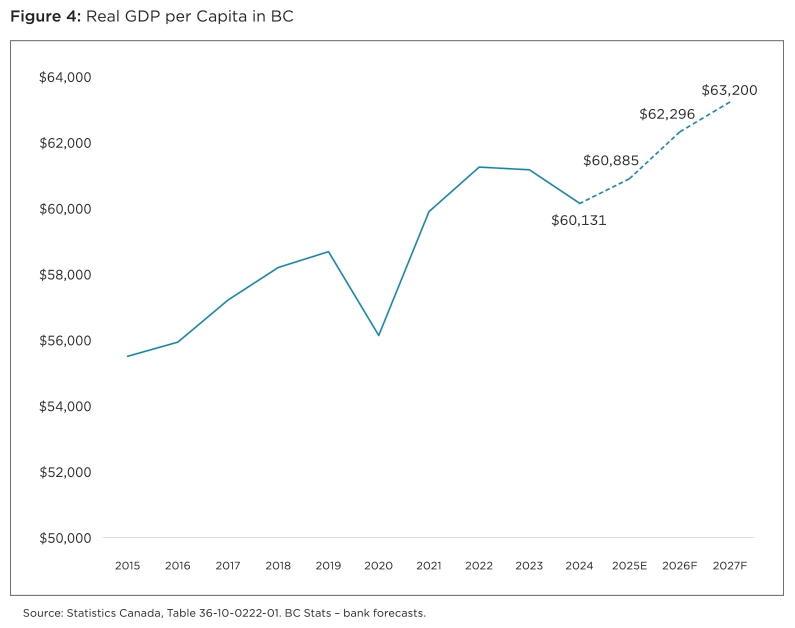
In tandem with steady growth, the policy reversal is expected to lead to an increase in economic output per person, which had declined between 2022 and 2024. Barring any major surprises in the GDP figures, 2025 is expected to mark an inflection point, with per capita GDP increasing by around 1.3%. That momentum is expected to continue in 2026 and 2027, as GDP per capita is forecasted to jump by 2.3% and 1.5%, respectively (see Figure 4).7
Inflation and interest rates expected to hold steady
The combination of steady inflation and interest rates is anticipated to remain a source of stability in 2026. The Bank of Canada (BoC) made four rate cuts of 25 basis points in 2025, resulting in a policy interest rate of 2.25% by year-end. At its first meeting of the new year on January 28, 2026, the bank held the policy rate, indicating its belief that the current policy rate is “appropriate” despite elevated uncertainty.8 Following the meeting, RBC noted that its base-case scenario has the BoC holding interest rates at 2.25% through the end of the year.9
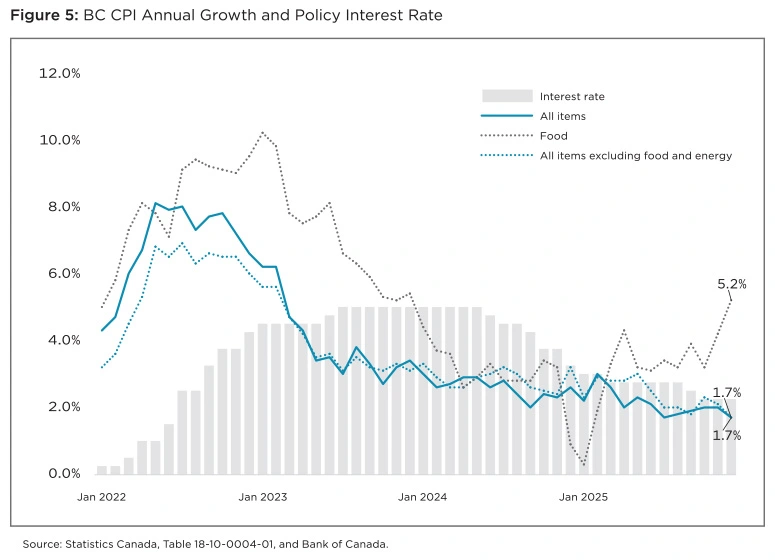
As of December 2025, year-over-year price growth in BC was the lowest among the provinces at 1.7%, 0.7 percentage points below the national average of 2.4%. The divergence from the national trend was driven by slower growth in food prices in BC, as well as base effects for travel accommodation,10 which normalized in 2025.
Overall, inflation in BC has been stable, but some categories still present upside risks. Food inflation remains elevated, rising 5.2% year-over-year in December 2025 (see Figure 5), while prices for all other items increased by 1.0%.
With the BoC signalling further cuts and pricing pressures largely contained, the outlook for 2026 points to a period of relative stability.
Four projects in Northern BC recommended to Major Projects Office
Investment in so-called “mega-projects”—headlined by the LNG Canada facility, Site C dam, and Trans Mountain Pipeline Expansion (TMX)—have helped cement BC’s position as a growth leader in Canada over the last decade. These projects will continue to serve BC’s economy through their operations but will leave a noticeable void in terms of construction and engineering output.
The most recent data from BC’s Major Projects Inventory (MPI) estimates that major projects worth a total of $385 billion were either underway, proposed, on hold, or recently completed in Q2 2025, down 1.7% from one year earlier. However, this total is a bit misleading, as the $40 billion LNG Canada facility is set to be removed when Q3 data is released, and investment in the project had already been spread over multiple years.
Similarly, the Site C dam was already partially operational by Q2 2025, with post-construction activities scheduled (for MPI purposes) to conclude in Q4 2025. (See page 25 for a regional breakdown of BC’s MPI.)
As for the opportunities that will come next (even if they do not completely match the level of investment reached previously), the picture is getting clearer. To date, 11 projects across the country have been referred to the Major Projects Office of Canada, which was created in August 2025 to help expedite projects deemed to be in Canada’s national interest.
Four of these projects are in British Columbia: Ksi Lisims LNG, LNG Canada Phase 2, the North Coast Transmission line, and the Red Chris mine expansion. These projects are at various stages of exploration and approval, with final investment decisions still pending.
Building investment driven by government capital spending
Building investment trends in 2025 were in line with 2024 levels (with December 2025 data still pending), but there were some shifts in terms of building type. Residential building investment increased by 1.5% year-over-year, offsetting a 3.0% decline in non-residential investment (see Table 1). Institutional and government spending has skyrocketed in recent years, driven by a surge in investment in health-care facilities. Housing starts, meanwhile, fell by 3.6% in 2025 as construction began on 44,193 housing units across the province; this represents a 12.5% pullback from the 2023 peak but remains above the 10-year average of 43,112.

Final thoughts
BC’s economy is poised for a moderate rebound in 2026, but many ups and downs are expected along the way. Trade, in particular, remains a source of volatility and uncertainty, and one that will continue to hamper business planning efforts. Nevertheless, there are signs of resilience and reasons for cautious optimism.
Jack Blackwell is CPABC’s economist.
This article was originally published in the March/April 2026 issue of CPABC in Focus.
Footnotes
1 The forecasts for the 2025 to 2027 GDP growth rates are based on the average forecast of four of Canada’s major banks (BMO, RBC, Scotiabank, and TD). Forecasts were made between December 2025 and January 2026.
2 Kyla H. Kitamura, Congressional Research Service, “U.S.-Canada Trade Relations,” In Focus (IF12595), congress.gov. Updated December 5, 2025.
3 Ibid.
4 Global Affairs Canada, “Softwood Lumber Recent Developments,” international.gc.ca.
5 Aaron McArthur and Amy Judd, “Canada-China Trade Deal Framed As a Win for B.C.’s Economy,” globalnews.ca, January 16, 2026.
6 Chuck Chiang, “B.C. and Feds Sign Lumber Understanding with China, As Province Looks Beyond U.S.,” cbc.ca, January 15, 2026.
7 Population data is from BC Stats Population Projections. The 2025-2026 GDP growth rates are based on an average forecast of four of Canada’s major banks (BMO, RBC, Scotiabank, and TD). Forecasts were made between December 2025 and January 2026.
8 Claire Fan, “Another Clear Hold from the BoC,” rbc.com, January 28, 2026.
9 Ibid.
10 Travel accommodation in BC spiked in December 2024, coinciding with high-profile concerts in Vancouver. Prices fell 35% year-over-year in the absence of similar headline events, according to Statistics Canada—see: “Consumer Price Index, December 2025,” The Daily, January 19, 2026.