
CPAs Matt Stam and Joni Rolleman chat about their trip to the Dominican Republic to volunteer as financial literacy educators in Haitian refugee communities.
Financial literacy doesn’t just change our understanding of money. It can help us shape our futures with confidence in life, in business, and beyond. According to the OECD, students who receive financial literacy education are more financially forward-looking, proactive, and more likely to save money.
Financial education also creates a positive ripple effect for communities as well as individuals. Two chartered professional accountants who know this firsthand are Matt Stam and Joni Rolleman. In late 2025, they travelled to the Dominican Republic to volunteer as financial literacy educators in Haitian refugee communities. According to the U.N., about 1.4 million Haitians have left their country because of instability and violence, and many now live in the Dominican. Matt and Joni, who both work at the accounting firm LLT LLP in Chilliwack, recently chatted with us about their trip.
How the seed was planted
When asked what sparked the idea for the trip, Matt says, “I first went to the Dominican in 2022 as a volunteer on a medical team. Then in 2024, our office went on our annual field trip to visit businesses in Chilliwack.” One of the organizations they visited was Hungry for Life, a charity that has partnerships globally to support the development of people in need. “There, we learned that in the Dominican, one area of need is for financial literacy skills,” notes Matt. “Those two experiences planted a seed that made me ask, ‘Is there a way that we could use financial literacy to help support communities?’”
Making the trip a reality
After talking with Hungry for Life about the possibility of partnering on a trip to the Dominican, LLT sent an office-wide survey to gauge interest. “There was quite a bit of enthusiasm,” says Joni. From there, LLT worked with Hungry for Life to put the trip logistics together and received cultural training. “CPABC also shared its financial literacy courses with us to use as teaching resources, so we formatted those for Dominican and Haitian audiences and had them translated into Spanish,” she says. All in all, the trip was about a year in the making.
Volunteering in sugarcane fields and cities
Once in the Dominican, the LLT team volunteered with audiences ranging from undocumented Haitian refugees to second- or third-generation Haitian residents. “We spent a good portion of our trip in Batey Vasca,” says Matt. “A batey is a community that is usually located in the middle of sugarcane fields. Many residents work as day laborers harvesting sugarcane and receive cash wages. They’re generally undocumented refugees with no true legal status in the Dominican. As a result, there’s not a lot of economic opportunity or income.” The team also volunteered in Juan Tomás, a city outside of Santo Domingo, and in Azua, a city near the Haitian border.
Financial literacy sparks “aha” moments
The skills that Matt and Joni taught generally focused on goal setting, establishing SMART goals, and creating and using a budget. “We also talked about the importance of savings and the impact compound interest can have on reaching financial goals,” says Matt.
“When we talked about budgeting, we saw a lot of people have breakthrough or “aha” moments,” recalls Matt. “They realized, ‘Wait, these are real numbers for our community. And if people use a budget and stick to it, they can actually start achieving real-world goals.’” Often, the room would come alive with excitement. “As accountants, wouldn’t think twice about a budget,” he says. “But the impact of something so simple can change lives, since people who budget are more likely to meet their financial commitments and save money.”
How CPA volunteers connected with students and entrepreneurs
In Batey Vasca, the LLT team volunteered with a youth group of about 45 people aged 14 to 20. “They gather on Saturdays to get extra education beyond what they receive at school and to talk about life skills and purpose,” says Matt. To connect with this audience, the team adapted their teaching materials. “This was probably the most impoverished area we visited,” says Matt. “Talking about money was difficult because so many of the students didn’t have money or the opportunity to make money. We adapted some of our presentations to be more about budgeting time and using your time wisely as opposed to talking about financial decisions.”
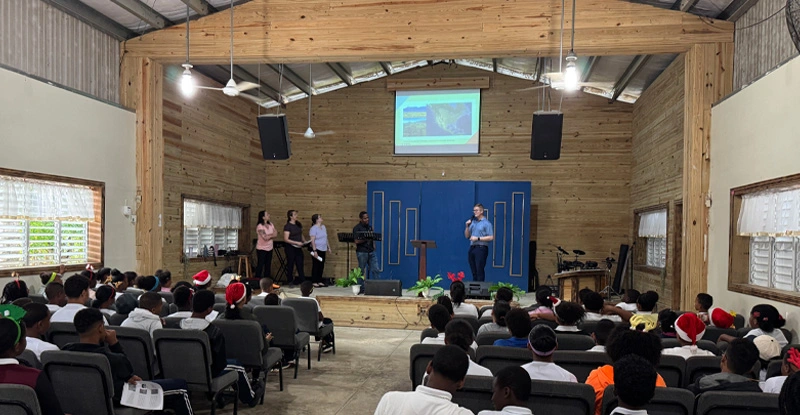
In Juan Tomás, the team spoke to about 200 students in grades 7 through 12 who are experiencing upward economic mobility. “Many of them are looking to go to university to become medical professionals, tourism workers, or teachers – careers that weren’t possibilities for the previous generation,” says Matt. The team also talked to entrepreneurs and small business owners in the city of Azua, sharing information on applying for loans and financial education needed to run a business. “These people are building out their businesses and getting to the next level of success,” he says.
The benefits of financial literacy take time
Matt believes the true impact of the trip will take a few years to materialize. Many of the entrepreneurs that LLT volunteered with are building their businesses from an idea into reality and applying for their first loans. And many of the students they spoke with will graduate in the next four or five years. “My hope is that 5 to 15 years from now, we’ll see long-term financial stability starting to build in some of these communities,” says Matt. “It’s possible that the people we talked with will be the leaders of tomorrow.”
A corner store and humanitarian aid
Matt notes that the team was able to make a difference in other areas, too. In Batey Vasca, LLT was able to sponsor a colmado, or corner store. “It’s the only store in the community and it allows people to get basic groceries, clothing, and supplies locally at competitive prices, rather than driving 45 minutes each way to town,” says Matt. The store also provides stable income to allow people to work in the community.
“When we weren’t teaching, we also participated in humanitarian volunteer opportunities,” says Joni. Matt helped a medical team to do inventory accounting and reconciliation, while Joni assisted on a health-related initiative called Days for Girls, run by Proinfancia. “We accompanied local volunteers teaching boys and girls in middle school about menstruation and how to care for themselves,” she says. “We also helped with community lunches and dropping off hampers. We basically said, ‘Let us know where we can help and we’ll jump in.’”
“Volunteering completely enriches your life”
For Joni, the value of giving back is deeply personal. “Volunteering, especially outside of your own community and your own language, pulls you out of your own frame of reference,” she says. “It gets you to see the world and people in a different light and it challenges you to get a different perspective on things. Volunteering completely enriches your life.”
For Matt, it’s about sharing a voice and a skill set that others can benefit from. “As accountants,” he says, “we tend to surround ourselves with people who see the world the way we do and have a similar skill set to us.” However, as people who are analytical, financially savvy, and logical, accountants might miss the impact those skills can have on the broader community. “CPAs aren’t the only voice that’s needed,” Matt says, “but we’re an important voice because we help people better understand their personal finances and businesses – and that has a long-lasting impact.”
Don’t be afraid to take the plunge
Sharing his final thoughts, Matt says, “If you’re considering doing something like this or you wish you had a chance to give back, just take the first step. It’s scary when you have an idea, but you don’t know if it’s going to work. If you just keep taking the next step and then the next step – all of a sudden, it’s real.”
Photo courtesy of LLT LLP.
Leah Giesbrecht is a communications specialist at CPABC.