
Practice Review Program Overview
The Practice Review Program (PRP) ensures protection of the public by assessing a firm’s compliance with professional standards, while delivering an educational experience for practitioners. When a firm is assessed as not meeting requirements (or “failing” their practice inspection), appropriate follow-up and/or remedial action is taken. A practice inspection will occur within the first year of a newly registered firm and every three years thereafter, which may be adjusted for certain risk factors that could cause the inspection cycle to be shorter.
All inspections are reviewed and/or approved by the Public Practice Committee on an anonymous basis. In determining the remedial actions for a firm, the Committee considers:
- Nature and severity of the identified findings;
- Adequacy and commitment of the firm’s response to address the significant findings;
- Co-operation of the practitioner(s) during the inspection process; and
- Overall risk to the public.
Introduction
This publication focuses on notable practice review observations from the past inspection year (April 1, 2025 to March 31, 2026), such as key highlights, significant themes that caused firms to not meet requirements, and common deficiencies across different engagement types. Lastly, the report will discuss areas of focus for the upcoming inspection year.
2025-2026 Inspection Highlights
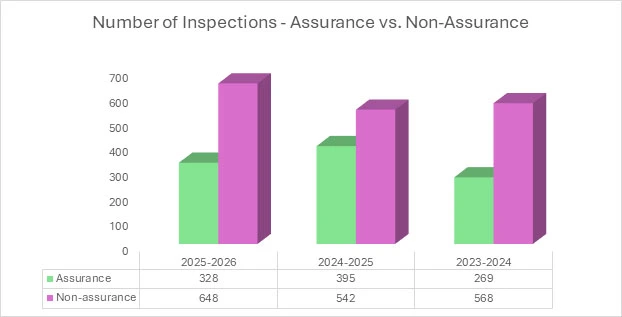
In the last inspection year, 976 practice inspections were completed, which is broken down as follows:
- 328 inspections of assurance firms (practices that perform both assurance and non-assurance engagements); and
- 648 inspections of non-assurance firms (practices that performed only non-assurance engagements).
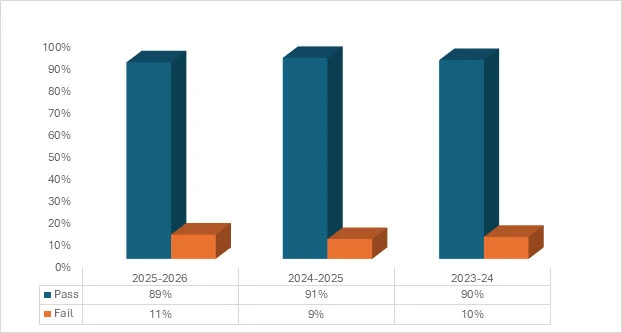
With respect to last year’s inspection results, the overall pass rate was 89%, which slightly dropped from the previous year. The decline was primarily due to an increased focus on higher risk assurance engagements which has been and will continue to be a central theme of the program.
Key Practice Review Observations
Assurance Engagements
In the last inspection year, the following themes were noted for assurance firms that did not meet requirements.
Financial Reporting:
- Amortization was not recognized and recorded in a rational and systematic manner appropriate to the nature of the item of property, plant and equipment. (Part II 3061, paragraph 16)
- Revenue from long-term contracts was not recognized using the percentage of completion method when the performance consisted of multiple acts and the enterprise could reasonably estimate the extent of progress toward completion. (Part II 3400, paragraphs 16-18)
- Government assistance drawn up it in the form of a loan that is forgiven was not accounted for in the same manner as a grant. (Part II 3800, paragraphs 24-25)
- When a financial liability was in default or breach of any term or covenants that permitted a lender to demand accelerated repayment during the period, there was no disclosure of this fact in the financial statements. (Part II 3856, paragraph 46)
- When externally restricted contributions were received, it was not recorded correctly based on the underlying restriction and method followed. (Part III 4410, paragraphs 31-46, 62-67)
Audit and Review Engagements:
- The auditor/practitioner did not sufficiently document the procedures performed on material classes of transactions, account balance and disclosures. (CAS 330, paragraphs 18-19, 25-28; CSRE 2400 paragraphs 46, 104)
- Cut-off, accuracy and completeness, and comparison and interrelationship of revenues especially related to
- Long-term contracts
- Restricted contributions
- Cut-off, accuracy and completeness, and comparison and interrelationship of revenues especially related to
- When providing an opinion/conclusion on an initial engagement the auditor/practitioner did not obtain sufficient appropriate evidence about whether opening balances contain misstatements that materially affect the current period’s financial statements. (CAS 510, paragraphs 5-9; CSRE 2400, paragraph 55)
In addition to the items noted above, the most commonly identified deficiencies are described below, with some of these having been noted in previous years. Each of these deficiencies could have a different degree of significance based on the facts and circumstances of that file (for example, who the users of the financial statements were), and the impact on the quality of work performed in that engagement file. The individual and cumulative impact of these deficiencies would factor in the overall assessment of the firm.
Financial Statement Presentation and Disclosure
Part II - 1505 Disclosure of Accounting Policies
- The financial statements did not provide a clear and concise description of the significant accounting policies of the enterprise. (paragraph 3)
Part II - 1510 Current Assets and Current Liabilities
- Assets that were not ordinarily realizable within one year from the date of the balance sheet were incorrectly presented as current assets. (paragraph 3)
- Cash subject to restrictions that prevent its use for current purposes were not excluded from current assets. (paragraph 7)
- Debt where the creditor had at the balance sheet date, or will have within one year from that date, the unilateral right to demand immediate repayment of any portion or all the debt under any provision of the debt agreement was not classified as a current liability. (paragraph 13)
Part II - 1540 Cash Flow Statement
- Investing and financing transactions that do not require the use of cash or cash equivalents were incorrectly included in the cash flow statement or not adequately disclosed in the notes to the financial statements. (paragraphs 41 and 48)
Part II - 3400 Revenue
- Inaccurate or incomplete disclosure of revenue recognition policy when entity had multiple types of material revenue transactions. (paragraph 31)
- Inaccurate or incomplete disclosure of contracts in progress at the end of the reporting period, accounted for using the percentage of completion method. (paragraph 32A)
- Major categories of revenue recognized during the period were not separately disclosed. (paragraph 33)
Part II - 3840 Related Party Transactions
- Disclosures regarding transactions with related parties were either missed or incomplete. (paragraph 51)
Part II - 3856 Financial Instruments
- Retractable or mandatorily redeemable shares issued in a tax planning arrangement were incorrectly presented in the equity section of the balance sheet when all conditions for equity recognition were not met. (paragraph 23)
- Disclosure regarding financial liabilities were missed or certain required elements were omitted, such as the aggregate amount of payments estimated to be required in each of the next five years, interest rate, maturity date, and repayment terms. (paragraphs 43-45)
- Incomplete or missing disclosure of retractable or mandatorily redeemable shares issued in a tax planning arrangement. (paragraph 47(c – e))
- The financial statements did not disclose the concentrations of risk for each type of risk arising from financial instruments. (paragraph 54)
Part III - 4410 Contributions – Revenue Recognition
- Financial statements did not properly disclose the policies followed in accounting for endowment and/or restricted contributions. (paragraph 21)
- Contributions by major sources were not separately disclosed in the financial statements. (paragraph 22)
- The financial statements did not disclose the nature and amounts of changes in deferred contributions balances for the reporting period. (paragraph 53)
BC Societies Act
- Remuneration that was paid by a society to the employees or persons under a contract with services that was at least the amount specified in the regulations was not disclosed in a note to the financial statements. (paragraph 36)
- Remuneration that was paid by the society to the directors in the period in relation to which the financial statements are prepared was omitted or missing the information required by the Act. (paragraph 36)
Audit Engagements
CAS 240 – The Auditor’s Responsibilities Relating to Fraud in an Audit of Financial Statements
- Missing or inadequate documentation of auditor’s inquiries of those charged with governance to determine whether they have knowledge or any actual, suspected or alleged fraud affecting the entity. (paragraph 32(c))
- Missing or inadequate documentation of the design and performance of audit procedures to test the appropriateness of journal entries recorded and other adjustments made in the preparation of the financial statements. (paragraphs 48-49)
CAS 315 – Identifying and Assessing the Risks of Material Misstatement
- The auditor did not perform analytical procedures as part of their risk assessment procedures (paragraph 14(b))
- The auditor did not obtain or adequately document an understanding of the entity and its environment and their system of internal control (paragraphs 19-27)
- Documentation of risk assessment procedures with respect to obtaining an understanding of control activities did not include an evaluation whether controls are designed effectively to address the risk of material misstatement at the assertion level or effectively designed to support the operation of other controls. (paragraph 26)
- When the auditor identified risks of material misstatements at the assertion level they did not assess and adequately document the inherent risk. (paragraph 31)
CAS 330 – The Auditor’s Responses to Assessed Risks
- The auditor did not document the design or performance of substantive procedures for material class of transactions, account balances and disclosures, including inadequate documentation regarding the linkage of those procedures with the assessed risks at the assertion level (paragraphs 18-19, 25-28)This includes common areas such as:
- Redeemable/retractable preferred shares
- Completeness of payables
- Expenses
- The auditor did not include or properly document an evaluation of the sufficiency and appropriateness of the audit evidence obtained. (paragraphs 25-27).
- The auditor did not include the linkage of the audit procedures performed with the assessed risks at the assertion level as part of their audit documentation. (paragraph 28 (b))
CAS 520 – Analytical Procedures
- As part of forming the overall conclusion the auditor did not design and performed analytical procedures near the end of the audit. (paragraph 6)
CAS 530 – Audit Sampling
- The auditor did not document the sample design, size and selection of items for testing. (paragraphs 6-8)
CAS 560 – Subsequent Events
- The audit procedures did not include an understanding of procedures management has established to identify subsequent events, or the inquiry with management and, where appropriate, those charged with governance as to whether any subsequent events have occurred that might affect the financial statements. (paragraphs 6-8)
CAS 580 – Written Representations
- The written representation from management was not appropriately dated as near as practicable to the date of the auditor's report. (paragraph 14)
CAS 700 – Forming an Opinion and Reporting on Financial Statements
- When supplementary information that was determined to not be an integral part of the financial statements the auditor did not ensure the information was presented in such a way to differentiate it from the audited financial statements or note it within their auditor’s report. (paragraph 54)
Review Engagements (CSRE 2400)
Performing the Engagement
- The practitioner did not or sufficiently document its understanding of the entity. Missing items such as accounting systems and accounting records, revenues, receivables and receipts or purchases, payables and payments cycles. (paragraphs 43-44)
- The practitioner did not identify areas of in the financial statements where material misstatement is likely to arise based on their understanding of the entity. (paragraph 45)
- The practitioner did not sufficiently document the inquiry and analytical procedures performed on material items and/or areas in the financial statements where material misstatements are likely to arise. (paragraphs 46, 104). This includes common areas such as:
- Expenses (inter-relationship/comparison)
- Related party receivables (collectability)
The documentation of the practitioner’s inquiries of management and others within the entity, as appropriate, did not include some or all of the inquires required. (paragraph 47)
Forming the Practitioner’s Conclusion on the Financial Statements
- The practitioner did not document their overall conclusion on whether limited assurance has been obtained regarding the financial statements being prepared, in all material respects, in accordance with the applicable financial reporting framework. (paragraphs 76-78)
The Practitioner’s Report
- The practitioner dated the report at a date earlier than the date on which (paragraph 103):
- The practitioner has obtained sufficient appropriate evidence as the basis for the practitioner’s conclusion on the financial statements;
- Those with recognized authority have asserted that they have taken responsibility for the financial statements.
Agreed Upon Procedures Engagements (CSRS 4400)
- When performing BC Financial Services Authority (BCFSA) or BC Law Society trust audit engagements, the practitioner did not issue the prescribed Agreed-Upon Procedures Report in accordance with the standard. (paragraph C31)
- When agreeing the terms with the engagement party, the engagement letter or other suitable form of written agreement did not properly include the required items. (paragraph 24)
System of Quality Management
The Canadian Standard on Quality Management (CSQM 1 and CSQM 2) is effective for all firms conducting other related services (i.e. compilation engagements and agreed-upon procedures engagements) and assurance services.
While most firms did have a system of quality management at the time of inspection, many of these firms encountered challenges meeting some of the core requirements of the standard, such as not establishing quality objectives, not identifying and assessing quality risks, or not having procedures documented regarding the monitoring and remediation process.
In some instances, we have seen non-assurance firms fail to adopt the system of quality management. When an entire standard has not been adopted, this will generally result in the firm not meeting requirements.
Compilation Engagements (CSRS 4200)
Practitioners have continued to demonstrate improvement in meeting the requirements of CSRS 4200; however, in instances when a practitioner failed to meet requirements, the following significant findings were identified:
- Not adopting CSRS 4200 – a Section 9200 Notice to Reader report was inappropriately attached to the compiled financial information prepared, and the working paper file did not meet any of the documentation requirements of the standard.
- Failure to include a basis of accounting note in the compiled financial information.
- Inaccurate or misleading basis of accounting note – stating that financial information was prepared in accordance with a general-purpose framework (e.g. ASPE) when there was no statement of cash flow and all/most of the disclosure requirements under that framework were not included. (paragraph 30)
- Insufficient adoption of CSRS 4200– the engagement file did not include any documentation of:
- Compliance with relevant ethical requirements, including an independence analysis or disclosure (paragraph 21);
- Engagement acceptance and continuance procedures (paragraphs 24-25);
- Knowledge of the entity’s business and accounting system (paragraph 29); and
- The acknowledgement of responsibility from management for the final compiled financial information (paragraph 35).
Other deficiencies noted in compilations were as follows:
- Missing one or more of the acceptance and continuance documentation requirements (paragraphs 24-25);
- Incomplete engagement letter whereby not all the requirements were included (paragraph 27); and
- Incorrectly dating the compilation engagement report (paragraph 40).
Tax Engagements
With respect to tax engagements (specifically T1 and T2 compliance), issues encountered were due to a lack of knowledge or procedures such as:
- Incorrect tax treatments (i.e. inappropriate deductions made in respect of an outlay or expense);
- Use of an incorrect or tax rate (i.e. applying the small business deduction to income that is not eligible income from an active business);
- Not adhering to client filing deadlines; and
- Not obtaining appropriate authorization from clients prior to filing the tax return (i.e. signed T183 form).
Deficiencies related to improper tax treatments or use of an incorrect tax rate could result in a firm not meeting the requirements.
Focus Areas for the 2026-2027 Practice Review Year
Higher Risk Assurance Engagements
The practice review program will continue to focus on assurance engagements that are considered “higher risk” which may target a specific industry type, a complex transaction area or work that does not make up a practitioner’s core area of practice. As a result, more extensive discussions are expected to occur during the file selection process and/or during the inspection of the file to ensure minimum professional standards are met.
Use of Artificial Intelligence (AI)
With the explosive growth of AI across different industries and sectors, the practice review team will seek to understand whether practitioners have adopted the use of AI within their practice and how it is being used in their engagements. Our primary focus will be to ensure that firms comply with all relevant professional standards, including the CPABC Rules of Professional Conduct, when AI has been deployed. We encourage our practitioners to refer to “A review of the CPABC Code of Professional Conduct and how it may relate to AI tool employment” guidance published by our advisory team.
Rate this Entry
Current rating: 23 yes votes, 1 no votes